Cast Steel Pressure Seal Gate Valves
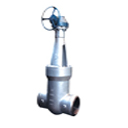
Product Overview
FAC Cast Steel Pressure Seal Gate Valves are designed in accordance with ANSI B 16.34 standards. Primarily used for stop valves fully opened or fully closed, these valves are ideal for high-pressure steam, gas, and oil applications where leakage through the bonnet joint must be prevented.
Downloads:
Technical Specifications
| General Construction | ANSI B 16.34 |
| Face to Face Dimensions | ANSI B 16.10 |
| Inspection & Testing | API 598 |
| Material Construction | As per ASTM A |
| Carbon Steel | WCB / A 105 |
| Stainless Steel | CF 8M / CF 8 |
| Class | 900, 1500, 2500 |
| Size | 2” to 12” |
| Flanged Ends | ANSI B 16.5 |
| Butt Weld End | ANSI B 16.25 |
Application & Function
Gate valves are primarily used for stop valves fully opened or fully closed. They are not normally considered for throttling purposes, but more for slurries, viscous fluids, etc.
Gate valves are characterized by a traveling wedge, which is moved with the operation of the stem nut. The wedge travels perpendicular to the direction of the flow. They usually have a minimum pressure drop when fully open, provide tight shut-off when fully closed, and remain relatively free of contamination buildup.
Body & Bonnet
The design of the body and bonnet is calculated to achieve the most regular distribution of stress in all directions, as well as the minimum turbulence and resistance to flow.
Valve bonnets are equipped with a backseat bushing. The yoke is integrally cast on Pressure Classes 150 and 300 up to 12” and up to 10” on Class 600 and higher ratings.
Construction Details
BODY-BONNET JOINT
Standard body-bonnet joints of gate valves are machined as follows:
EMFLO can supply any style of gasket required by customer.
GATE (WEDGE)
All gates are fully guided to the seats. As standard our valves are supplied with a solid flexible gate that has a tapered H cross-section. The flexible wedge is cast or machined with a circumferential groove to allow the seating surfaces to move independently and adjust to movement of the body seats. This design is beneficial where line loads or thermal expansion of the system is likely to distort the seat face.
SEAT RING
Seat rings are designed to greatly reduce and/or prevent any turbulence and avoid damages due to the corrosion. The seat rings are forged or rolled in one piece, and then seal welded and overlaid, if required. After welding and all required heat treating, the seat ring faces are machined, thoroughly cleaned and inspected before leaving for assembly.
STEM
The stem connection to the gate is a T-head design which is integral (without welding) with the stem. The accuracy in the dimensions and finishes assure a long life with a perfect tightness in the packing area, resulting in lower fugitive emissions. The stem-to-gate connection is designed to prevent the turning or the disengagement of stem from the wedge while the valve is in service.
STEM PACKING
The stem packing is designed and arranged to ensure a maximum seal along the stem during operation or while at position, thus allowing for a greater reduction in fugitive emissions. Our packings are NON-ASBESTOS types. EMFLO can supply any style of packing required by our customer.
STUFFING BOX
The depth of the stuffing box allows for a sufficient amount of packing, which makes the stem seal. Our standard packing arrangement and stuffing box design meets <100 ppm fugitive emission requirements. If specified in the purchase order, lantern rings and/or grease injectors can be furnished.
PACKING GLAND
The packing gland design is a two-piece self-aligning type. The gland proper has a spherical head that rides within the spherical joint of the gland flange. The gland proper has a shoulder, which restricts the complete entry into the stuffing box bore. This particular design assures a straight compression of the packing as the gland eyebolts are being equally adjusted, without injuring the stem.
STEM NUT
The stem nut arrangement and design allows for the removal of the handwheel without allowing the stem and gate to drop into the closed position if the handwheel is removed while the valve is in the open position. Ball bearings are provided in the stem nut arrangement of Class 150 valves from NPS 14”, on Class 300 valves from NPS 12”, on Class 600 valves from NPS 6”, and on Classes 900-1500 valves from NPS 2”.
Key Features
Flexible Wedge
Tapered H cross-section gate allows seats to move independently.
Low Fugitive Emissions
Packing design meets <100 ppm emission requirements.
Self-Aligning Gland
Two-piece spherical head design ensures straight compression.
Integral T-Head
T-head stem connection prevents disengagement in service.
End Connections & Accessories
Standard production covers valves with:
- Flange ends with Raised Face (RF), Flat Face (FF) or Ring Type Joint (RTJ) that conform to ANSI B16.5.
- Butt-welding ends (BW) that conform to ANSI B16.25.
- All face-to-face/end-to-end dimensions conform to ANSI B16.10.
- Other special end connections are supplied according to customer’s requirements.
Bolting: For normal service, ASTM A194 Class 2H and ASTM A193 Grade B7 nuts and stud bolts are furnished. For high temperature, ASTM A194 Class 4 and ASTM A193 Grade B16 are furnished. Stainless valves use ASTM A194 Class 8 and ASTM A193 Grade B8.
Accessories Include: Gear operators, actuators, bypasses, locking devices, chainwheels, extended stems and bonnets for cryogenic service and many others are available to meet the customers requirements.
For 1,500 # and 2,500 # and special material details will be provided on request.