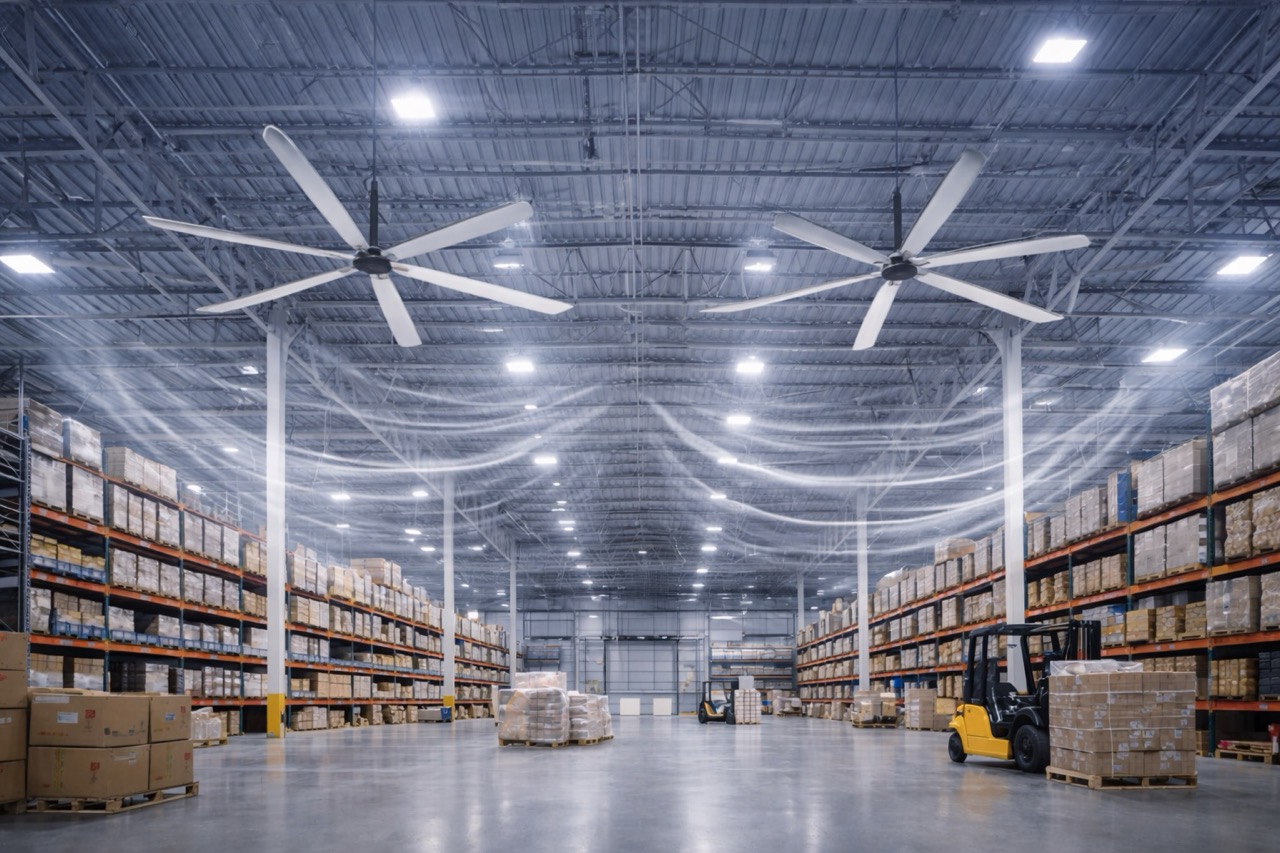
WCSIPL delivers complete electrical engineering solutions for HVAC projects — from HT/LT panel fabrication and power distribution to control wiring, lighting systems, and BMS integration — ensuring safe, reliable, and code-compliant electrical infrastructure for commercial, industrial, and critical facilities.
HVAC Electrical encompasses all electrical infrastructure required to power, control, and protect HVAC systems — including high-tension (HT) and low-tension (LT) power distribution panels, motor control centers (MCC), variable frequency drive (VFD) panels, control wiring for sensors and actuators, emergency power systems, and integrated building management system (BMS) connectivity.
Proper electrical design is the backbone of any HVAC installation. Undersized cables, incorrect protection settings, or poorly designed control circuits can lead to frequent breakdowns, energy waste, safety hazards, and non-compliance with IE rules and IS standards. WCSIPL's in-house electrical engineers design every aspect — from load calculations and cable sizing to panel schematics and interlock logic — ensuring your HVAC system operates reliably and safely.
WCSIPL provides end-to-end HVAC electrical services including HT/LT panel design and fabrication, power and control cable laying, tray and conduit installation, VFD and soft-starter integration, HVAC control panel wiring, lighting for plant rooms and outdoor equipment areas, earthing and lightning protection, and commissioning with thorough testing and documentation.
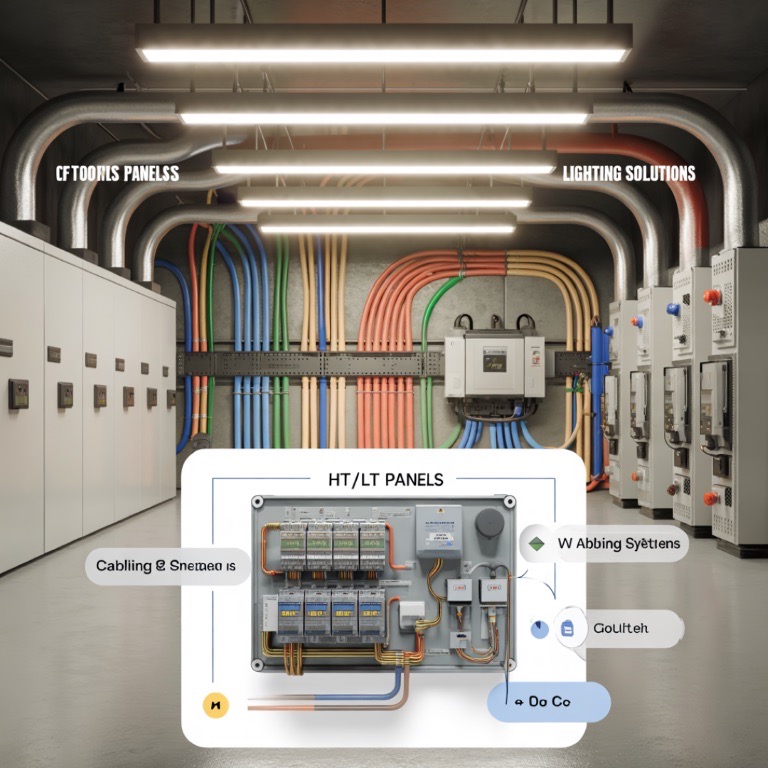
Every WCSIPL electrical installation is engineered for safety, reliability, energy efficiency, and full compliance with Indian electrical standards.
Custom-designed HT (11kV/33kV) and LT (415V) panels including APFC panels for power factor correction, VFD panels for motor speed control, and MCC panels for centralized motor protection and control — all fabricated to IS 8623 and IS 375 standards.
Precisely sized power cables and control wiring as per IS 1554 and load calculations — laid in GI trays, perforated trays, or GI conduits with proper glanding, termination, and cable identification for easy maintenance and troubleshooting.
Energy-efficient LED lighting designs for AHU rooms, chiller plants, outdoor equipment areas, and plant rooms — including emergency lighting, illuminated exit signs, and lighting for maintenance access areas with appropriate IP ratings.
Variable frequency drives and soft starters for HVAC motors — reducing starting current surges, minimizing mechanical stress, and enabling energy-optimized fan and pump speed control based on actual load conditions via BMS signals.
Comprehensive protection coordination including MCCB/ACB selection, earth fault relays, overload protection, short-circuit coordination, and phase failure protection — designed as per IE Rules 1956 and IS standards for personnel and equipment safety.
Complete BMS wiring and integration for HVAC electrical systems — connecting VFDs, motors, sensors, actuators, and panels to the building management system via BACnet, Modbus, or LonWorks protocols for centralized monitoring and control.
Integrated HVAC and electrical expertise under one roof — eliminating coordination gaps and ensuring seamless project delivery.
In-house electrical engineers with deep HVAC domain knowledge design every panel, cable, and control circuit for optimal performance and safety.
From load calculation and panel fabrication to cable laying, termination, testing, and commissioning — single-point accountability for the entire electrical scope.
Every installation meets IS standards, IE Rules 1956, NBC 2016 electrical requirements, and local electrical inspectorate norms for hassle-free approvals.
Rapid electrical breakdown response with SLA-backed AMC programs — our electricians are always available to minimize HVAC downtime.
Load calculations, power distribution studies, and fault protection analysis for HVAC systems.

Complete supply, installation, testing, and commissioning under single-point responsibility.

State-of-the-art protection systems to minimize downtime and electrical hazards.

Optimized cabling, lighting, and panel design to reduce energy losses and operational costs.

Adherence to national and international electrical standards for critical HVAC applications.

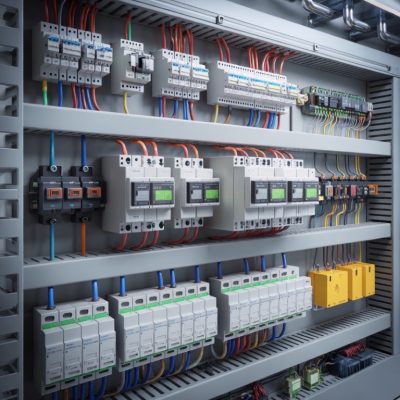
WCSIPL delivers every element of HVAC electrical infrastructure — designed, fabricated, installed, and commissioned to the highest standards.
Custom-designed and fabricated HT (11kV/33kV) and LT (415V) panels including VCB panels, ACB/MCCB panels, APFC panels for power factor correction, VFD panels with bypass arrangements, and HVAC-specific motor control centers. All panels fabricated with IS 8623 certified enclosures, quality busbars, and reputed brand switching and protection devices with proper ventilation and IP rating for the installation environment.
Complete cable installation services including power cable laying from source to HVAC equipment in GI cable trays, perforated trays, or GI conduits as per site requirements. Control cable installation from panels to field instruments with proper segregation, glanding, ferruling, and identification. Includes cable tray fabrication, support brackets, fire-rated cable wrapping for critical circuits, and cable entry/exit protection through panels and enclosures.
Designed lighting systems for AHU rooms, chiller plants, outdoor condenser yards, and equipment service areas — using energy-efficient LED fixtures with appropriate lux levels, IP ratings (IP54/IP65 for wet areas), and color temperatures. Includes emergency lighting with battery backup, illuminated exit signage, and lighting for safe maintenance access around rotating equipment and at height. Lighting control integration with BMS for occupancy-based and time-based switching.
Complete earthing systems including equipment earthing, panel earthing, and body earthing as per IS 3043 — with earth pit construction, earth electrode installation, and earth resistance testing to achieve required values. Lightning protection system design and installation as per IS 2309. Safety systems including emergency stop circuits, lockout/tagout provisions, arc flash protection, and proper PPE-rated panel access for HVAC electrical maintenance personnel.
Common questions about HVAC electrical solutions answered by our engineering team.
HT (High Tension) panels operate at voltages above 1000V — typically 11kV or 33kV in India — and are used to receive power from the utility transformer and distribute it to step-down transformers. LT (Low Tension) panels operate at 415V (3-phase) or 240V (single-phase) and distribute power from the transformer to individual HVAC equipment like chillers, AHUs, pumps, and fans. In large HVAC installations, power flows from HT panel → transformer → LT panel → VFD/MCC panel → equipment. WCSIPL designs both HT and LT panels as an integrated system with proper protection coordination.
Variable Frequency Drives (VFDs) control motor speed by varying the frequency and voltage of the power supply to the motor. In HVAC, most motors don't need to run at 100% speed all the time — a chiller compressor might only need 60-70% capacity during partial load conditions. Without a VFD, the motor runs at full speed and uses throttle valves or dampers to reduce output, wasting significant energy. VFDs reduce motor speed to match actual demand, saving 20-40% energy. They also eliminate the high starting current (6-8 times FLA) that occurs with DOL starters, reducing stress on electrical infrastructure and mechanical components.
An APFC (Automatic Power Factor Correction) panel automatically maintains the power factor close to unity (0.95-0.99) by switching capacitor banks in and out based on the reactive power demand. HVAC systems, especially those with induction motors (chillers, fans, pumps), have inherently low power factors (0.7-0.85) due to inductive loads. Low power factor causes higher current draw, increased I²R losses in cables, reduced transformer capacity, and penalty charges from the electricity board. APFC panels eliminate these penalties and free up electrical capacity — often reducing electricity bills by 10-15%.
Safety is integrated into every stage of our electrical work. During design: proper protection coordination study, cable derating factors, and short-circuit analysis. During fabrication: quality components, proper busbar sizing, adequate clearances, and IP-rated enclosures. During installation: proper earthing, cable segregation, glanding, and identification. During commissioning: insulation resistance testing, earth continuity verification, protection relay testing, and interlock verification. We follow IS 3043 (earthing), IS 732 (wiring), IE Rules 1956, and NBC 2016 — and provide complete safety documentation including single-line diagrams and emergency procedures.
Yes, this is one of WCSIPL's key differentiators. We have in-house teams for both HVAC mechanical (chillers, AHUs, ducting, piping) and HVAC electrical (panels, cables, controls, BMS) — working under a single project manager. This eliminates the coordination gaps, blame-shifting, and interface issues that commonly occur when mechanical and electrical are handled by separate contractors. Our integrated approach ensures the electrical system perfectly matches the mechanical design, commissioning is seamless, and there's a single point of accountability for the entire HVAC system performance.
We provide a comprehensive electrical handover package including: as-built single-line diagrams, panel schematic diagrams, cable schedule and layout drawings, protection relay setting sheets, insulation resistance test reports, earth resistance test reports, VFD parameter setting sheets, motor test certificates, equipment warranty certificates, BMS point list and I/O test reports, operation and maintenance manual, and a spare parts list. For pharma and cleanroom projects, we additionally provide IQ (Installation Qualification) documentation as part of the validation package.