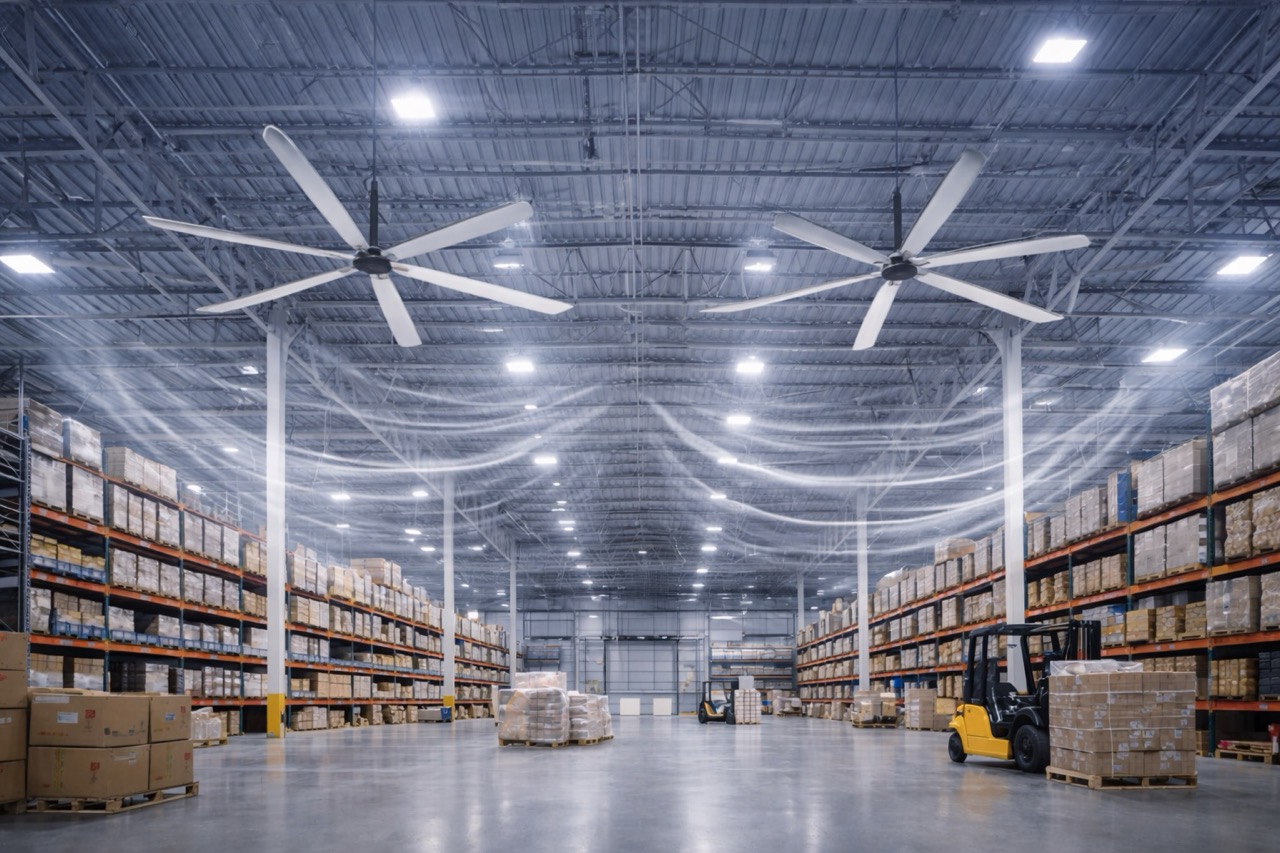
WCSIPL's Two-Stage Evaporative Cooling delivers precision temperature and humidity control for food production environments — combining indirect pre-cooling with direct evaporative cooling for unmatched efficiency, hygiene compliance, and product safety.
Two-stage evaporative cooling is an advanced cooling technique that combines two distinct cooling processes in sequence — first an indirect evaporative cooling stage that cools air without adding moisture, followed by a direct evaporative cooling stage that further reduces temperature through water evaporation.
This dual approach achieves supply air temperatures far below what single-stage systems can deliver — typically 18–24°C from 42°C+ ambient — while keeping humidity at manageable levels. The result is a cooling solution that rivals mechanical refrigeration in performance but at a fraction of the energy cost, making it ideal for snack production, food processing, and other humidity-sensitive industrial environments.
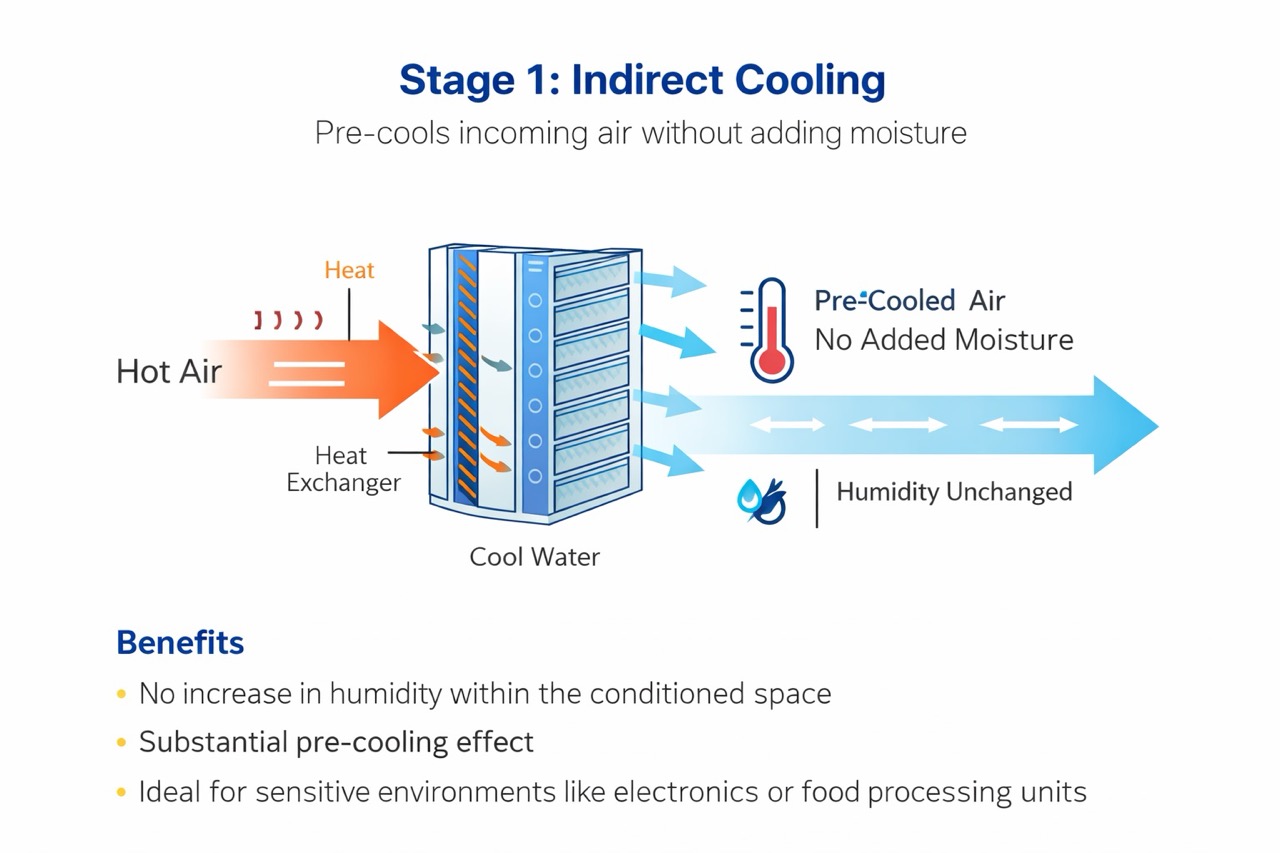
Two-stage evaporative cooling combines an indirect pre-cooling stage with a direct evaporation stage to achieve lower temperatures than single-stage systems — without adding moisture to the supply air in the first stage.
Hot outdoor air passes through the dry channel of a plate-type heat exchanger. Simultaneously, a separate airstream is cooled by water evaporation in the wet channel on the opposite side of the plates. Heat transfers from the dry supply air to the wet side through the conductive plates — cooling the supply air by 5–10°C without increasing its humidity. This pre-cooled, dry air then proceeds to Stage 2 for further temperature reduction.
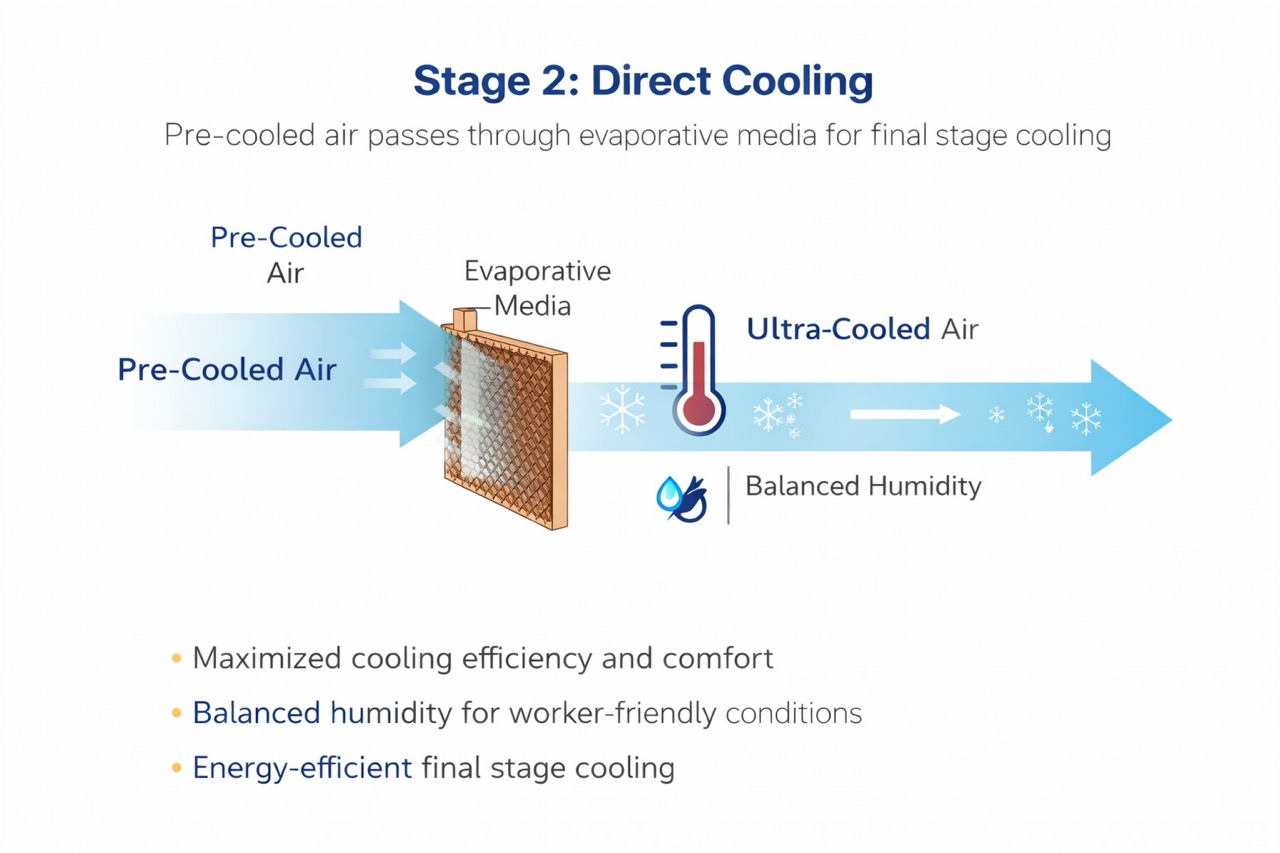
The pre-cooled air from Stage 1 passes through saturated cellulose cooling pads (typically 150mm cross-fluted) where direct water evaporation further reduces the temperature. Because the incoming air is already 5–10°C cooler, the direct stage achieves a much lower final temperature — often reaching 18–24°C supply air from 42°C+ ambient. The overall humidity increase is significantly less than a single-stage system would produce.
For food production and sensitive manufacturing environments, two-stage cooling delivers what single-stage systems cannot — lower temperatures, controlled humidity, and consistent performance even during peak summer.
Two-stage systems achieve 50–70% more cooling than single-stage units using the same energy input. The indirect stage captures "free" cooling from the wet channel, reducing overall fan energy by 30–40% compared to single-stage operation.
While single-stage cooling typically achieves 8–12°C drop, two-stage systems deliver 15–22°C reduction — consistently supplying 18–24°C air even when ambient exceeds 42°C, critical for snack frying and packaging zones.
The indirect stage cools without adding moisture, so final humidity after Stage 2 is significantly lower than single-stage output. Essential for snack production where excess humidity affects product crispness, texture, shelf life, and packaging integrity.
| Parameter | Single-Stage Evaporative | Two-Stage (WCSIPL) |
|---|---|---|
| Temperature Drop | 8–12°C | 15–22°C |
| Supply Air (at 42°C ambient) | 30–34°C | 20–24°C |
| Humidity Added to Supply Air | High (direct evaporation only) | Moderate (controlled two-step) |
| Energy Consumption per TR | 0.04–0.08 kW | 0.03–0.06 kW |
| Wet-Bulb Effectiveness | 80–90% | 100–115% |
| Suitability for Food Production | Limited (high humidity) | Excellent (controlled humidity) |
| Best Application | Warehouses, open areas | Food mfg., pharma, electronics |
Engineered for food-grade environments, WCSIPL two-stage systems deliver a unique combination of cooling performance, energy savings, and hygienic design.
Consumes only 0.03–0.06 kW per tonne of cooling versus 0.7–1.2 kW/TR for mechanical refrigeration — rapid payback within 6–12 months.
SS304/316 heat exchangers, food-safe cellulose pads, and antimicrobial water treatment ensure FSSAI, HACCP, and BRC compliance.
Reliably maintains supply air at 18–24°C even during peak summer (42°C+ ambient), ensuring stable production conditions year-round.
Continuous fresh air supply dilutes airborne contaminants, removes heat and cooking fumes, and maintains positive pressure for food safety.
Uses only water as the cooling medium — zero CFC/HCFC refrigerants, zero ozone depletion, zero global warming impact.
No compressors or complex refrigeration circuits — maintenance limited to pads, water treatment, and fan servicing, reducing AMC costs by 60–70%.
WCSIPL two-stage evaporative cooling systems are purpose-built for environments that demand precise temperature control, fresh air ventilation, and hygienic operation — making them the ideal choice for food production and sensitive manufacturing.
With 17+ years of HVAC engineering expertise, WCSIPL is the trusted partner for industrial evaporative cooling across India.
Founded in 2008, designed and installed 500+ industrial cooling systems across India.
From snack factories to pharma plants — proven track record across diverse industries.
Every system is designed from scratch for your facility — not off-the-shelf products.
Dedicated service teams with AMC coverage and rapid response across India.